 Best IT Solutions Company in UAE | H7 Labs FZEBest IT Solutions Company in UAE | H7 Labs FZE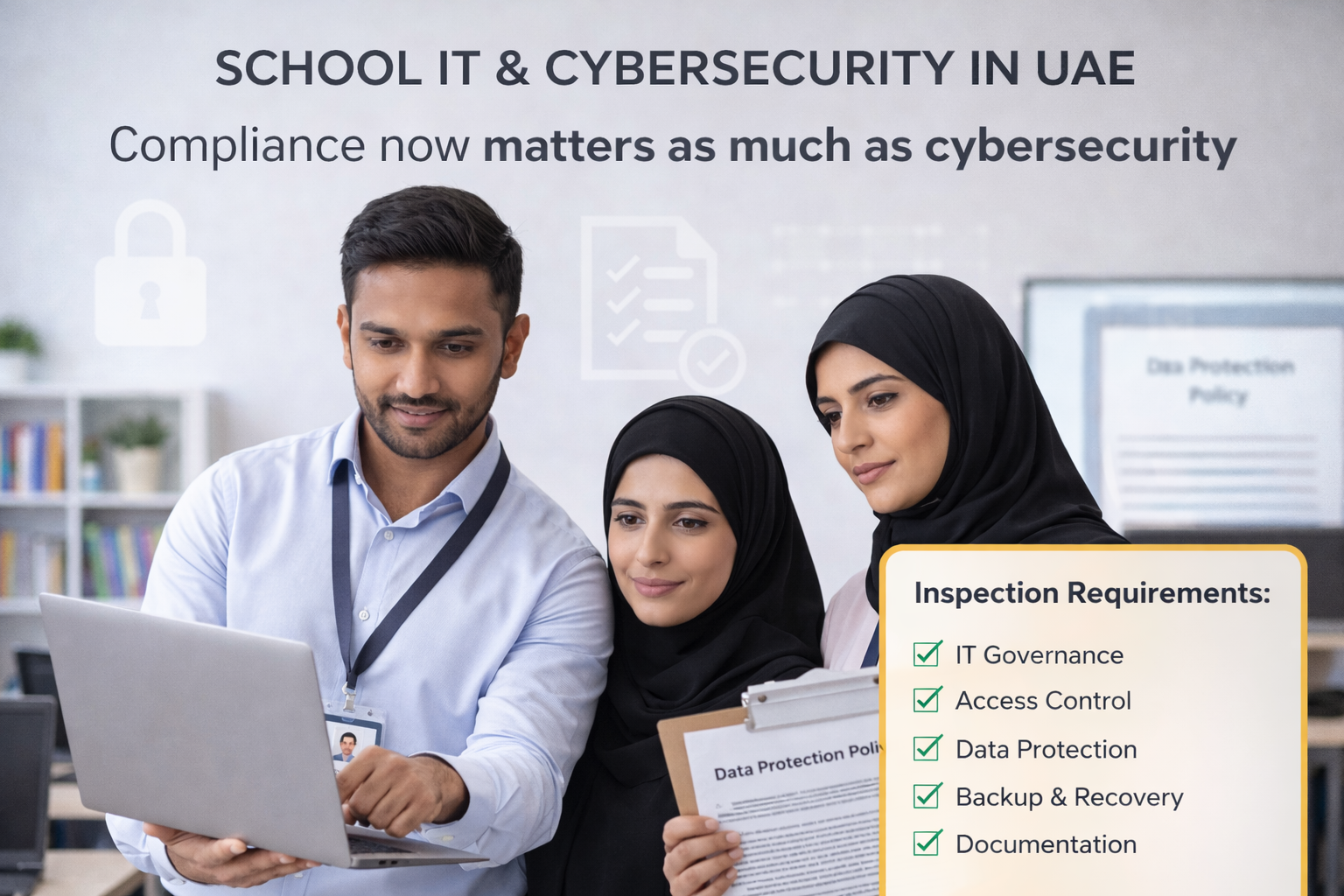
School IT in the UAE is no longer about keeping systems running.
It is now about compliance, governance, and inspection readiness.
Over the last few years, UAE education authorities have raised expectations around:
Data protection
Digital governance
Risk management
Evidence-based inspections
Today, schools are evaluated like regulated digital organisations, not traditional academic institutions.
This means every school in the UAE must treat IT and cybersecurity as a leadership responsibility, not an operational task.
Most school leaders still think cybersecurity equals hackers.
That is outdated thinking.
In 2026, the real risks are:
Failing KHDA, ADEK, or MOE inspections
Inability to produce compliance evidence
Weak access control policies
Shadow IT across departments
Untested backups
Poor data ownership models
Schools are far more likely to fail an audit than experience a cyberattack.
And audits leave paper trails.
True School IT & Cybersecurity in UAE consists of six pillars:
Who owns decisions?
Who approves systems?
Who controls vendors?
Without governance, compliance is impossible.
Who can access student data?
Who can access finance systems?
Who leaves with access still active?
Access sprawl is the number one hidden risk in schools.
Where is student data stored?
Is it encrypted?
Is it shared with third parties?
Most schools violate data principles without realising it.
Are backups tested?
Are they offline?
Can the school recover in 24 hours?
Untested backups are not backups.
Acceptable use policies
Data retention policies
Incident response plans
If it’s not documented, it doesn’t exist during inspections.
Logs
Access records
System inventories
Risk registers
Inspectors do not trust statements.
They trust evidence.
Here’s the uncomfortable truth:
Most schools believe they are compliant because:
They have an IT provider
They use Microsoft or Google
They have antivirus
They have Wi‑Fi policies
None of this proves compliance.
Compliance requires:
Ownership structures
Audit trails
Governance models
Documentation frameworks
Measurable controls
Security tools ≠ compliance.
Shadow IT is the biggest silent failure point.
Examples:
Teachers using personal Google Drives
Departments using unapproved SaaS tools
Student data shared via WhatsApp
Staff using personal devices without controls
Shadow IT destroys:
Data governance
Access control
Compliance posture
Legal defensibility
And almost every school has it.
Inspectors rarely ask technical questions.
They ask leadership questions:
Who owns IT risk?
Who approves systems?
How do you manage access?
How do you protect student data?
Can you show evidence?
Schools fail not because systems are bad.
They fail because answers are unclear.
This is the practical model high-performing schools follow:
Digital governance committee
Named IT owner
Clear reporting structure
Data protection policy
Access control policy
Acceptable use policy
Incident response plan
Approved platforms only
Vendor risk assessments
System inventory
Role-based access
Offboarding process
Quarterly access reviews
Logs
Reports
Risk registers
Audit records
This model is inspection-proof.
Traditional IT companies focus on:
Tickets
Devices
Networks
Support
School IT & Cybersecurity Specialists focus on:
Compliance
Governance
Risk
Inspections
Leadership reporting
These are completely different skill sets.
One keeps systems running.
The other keeps schools legally safe.
The biggest mistake school leaders make is thinking:
“We haven’t had problems, so we’re fine.”
That logic fails in inspections.
Modern school cybersecurity in UAE is not reactive.
It is governance-driven, evidence-based, and leadership-owned.
The schools that succeed in 2026 will not be the most technical.
They will be the most structured.
If you are a school owner, principal, director, or operations leader in UAE and want:
Inspection-ready IT
Full compliance framework
Risk visibility
Governance clarity
Leadership-level reporting
Then you need a School IT & Cybersecurity Specialist, not generic IT support.
Book a School IT Compliance Assessment and get a full gap analysis against UAE inspection standards.